CoderBunnyz vs ThinkFun Hacker: Which Coding Game Fits Your Kid?
ThinkFun Hacker is a well-made, screen-free logic puzzle about cybersecurity for ages 10 and up. Here is what it teaches, what it does not, and how it compares to CoderBunnyz for younger kids and family play.
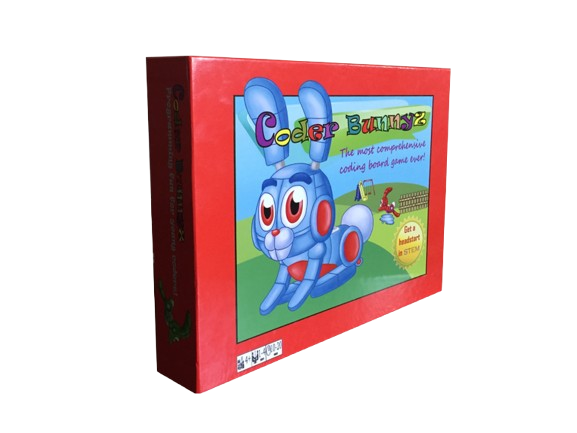
About $36 · screen-free · free curriculum
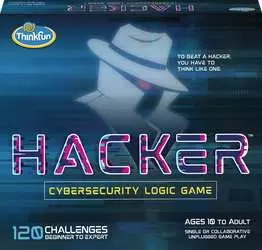
About $33 · 120 challenges · one player
Who wrote this
This comparison is published by CoderBunnyz. We make one of the two games below. We have written it to be genuinely fair, including recommending Hacker where it is the better pick. Ages, challenge counts and prices come from ThinkFun’s listings and each game’s box.
The short answer
These two games solve different problems, so the honest answer is: pick by child, not by brand. ThinkFun Hacker is the better choice for a 10-plus-year-old who loves cracking hard puzzles alone. CoderBunnyz has no solo mode and nothing like Hacker’s cybersecurity theme. CoderBunnyz is the better choice below age 10 or for family play: it starts at 4, seats 2 to 4 players, and grows from sequencing to functions and inheritance. Many families own both.
What ThinkFun Hacker actually is
Hacker is a single-player logic puzzle from ThinkFun (the makers of Rush Hour), designed by Mark Engelberg, who also created Code Master. It is unplugged, meaning no screen or app is required. You program an agent to move across a grid to collect data chips while avoiding viruses and alarms, then you learn to secure your own program against attacks. It ships with 120 challenges that scale from beginner to expert, a game grid, control panel, tokens, and a solution booklet, and it holds a 4.4 out of 5 rating across roughly 720 reviews.
Good to know before you buy
Hacker is mainly a solo brain-teaser (like Rush Hour), not a take-turns party game, and it is rated for ages 10 and up. Reviewers love the challenge but note it can be genuinely complex, even for adults, so it suits kids who already enjoy hard logic puzzles.
ThinkFun Hacker vs CoderBunnyz at a glance
| CoderBunnyz | ThinkFun Hacker | |
|---|---|---|
| Ages | 4 to 104 | 10 and up |
| Players | 2 to 4 (family & classroom) | 1 (solo logic puzzle) |
| Format | Screen-free board game | Screen-free solo puzzle |
| What it teaches | Sequencing, conditionals, loops, functions, inheritance | Programming logic, concurrency, cybersecurity concepts |
| Challenge range | Multiple levels + bonus cards | 120 challenges, beginner to expert |
| First-time coder friendly | Yes, from age 4 | Better once kids like hard puzzles |
| Free curriculum | Yes, standards-aligned | Challenge + solution booklet only |
| Price | Around $36 | Around $33 |
| In stock in 2026 | Yes, ships today | Yes, ships today |
What each game teaches
Hacker introduces programming logic through a cybersecurity story: plan a sequence of moves, then reason about concurrency (how a program behaves as pieces interact) and how to protect it. It teaches concepts rather than syntax, and the difficulty ramps up quickly, which is exactly what puzzle-loving older kids want.
CoderBunnyz starts in a friendlier place, hop your bunny to the carrot, so a 4-year-old can play on day one. The same box then introduces conditionals, loops, functions, inheritance and more, so it keeps challenging a 10-year-old, a parent, or a whole classroom. Because it seats 2 to 4 players, it is built for playing together, not just solving alone.
ThinkFun Hacker: pros and cons
- Pro: excellent, meaty logic puzzles that feel like real problem-solving.
- Pro: screen-free, high-quality components, clear instructions.
- Pro: cybersecurity theme is a fresh, motivating hook for older kids.
- Con: rated ages 10 and up, so it is a stretch for younger children.
- Con: mostly single-player, so it is not a shared family game night.
- Con: can be complex to grasp, and it teaches concepts more than hands-on coding for beginners.
Where CoderBunnyz falls short next to Hacker
- No solo mode: CoderBunnyz needs 2 to 4 players, so it cannot fill quiet-time alone the way Hacker does.
- No cybersecurity angle: if the hacking theme is what excites your kid, CoderBunnyz does not offer it.
- Less bite at the top for a puzzle-hungry 12-year-old playing casually. Hacker’s expert challenges are genuinely hard.
Choose Hacker / choose CoderBunnyz
- Choose ThinkFun Hacker if your child is 10 or older, likes to sit and crack hard puzzles solo, and is drawn to the hacking and cybersecurity theme.
- Choose CoderBunnyz if you want to start younger (age 4 and up), play together as a family or class, and have one game that grows from a first sequence of moves to functions and inheritance, backed by a free curriculum.
- Using both works well: Hacker for solo quiet time, CoderBunnyz for family game night. They overlap surprisingly little.
CoderBunnyz is in stock today, ships fast, and teaches real coding from your very first hop.
Frequently asked questions
Is ThinkFun Hacker good?
Yes. ThinkFun Hacker is a well-reviewed (4.4/5), screen-free logic puzzle for ages 10 and up that teaches programming logic and cybersecurity concepts across 120 challenges. It is best for kids who enjoy hard solo puzzles.
What age is ThinkFun Hacker for?
Hacker is rated for ages 10 and up, and reviewers note it can challenge adults too. For younger children, CoderBunnyz starts at age 4 and grows with the child.
Is ThinkFun Hacker a multiplayer game?
No. Hacker is primarily a single-player logic puzzle, similar to Rush Hour. If you want a coding game for 2 to 4 players and family game night, CoderBunnyz is designed for group play.
What is a good ThinkFun Hacker alternative for younger kids?
For kids under 10, CoderBunnyz is the closest fit: a screen-free coding board game for ages 4 to 104 and 2 to 4 players that teaches sequencing through to functions and inheritance, with a free curriculum. Note that it is multiplayer, not a solo puzzle like Hacker.
Keep reading
Comments
Be the first to comment.